What play did you experience as a child that was dangerous or adventurous? How did it feel? What did you like about it and do you have any elements of that feeling in your life now? Are you finding ways for your children and/or grandchildren to play in ways that include appropriate levels of danger?
The books I’m reading right now are about other cultures and how they raise children differently than in the United States. I’m interested in these books because our culture seems to make many weird decisions. I was first tipped off to this when two doulas suggested to me the work and writings of Ina May Gaskin, an old school doula. Gaskin critiques how we give birth in the United States saying we focus on fear and pain. She talks extensively about women’s bodies being created to do the work of birthing yet we think of the process as painful rather than powerful. Her writing is compelling. I also wondered, if we’re doing this wrong, what else are we doing wrong?
Apparently, we’re doing a lot wrong. Michaeleen Doucleff talks about WEIRD parenting in her book, Hunt, Gather, Parent. She refers to work that Joe Henrich from British Columbia has done in psychology, which has “led to a fundamental shift in the entire field of psychology.” (p19.) He doesn’t just experiment on European people. He travels the world to observe different cultures to see how they respond to his experiments. With his friend and colleague, Steve Heine, he started to observe differences in North Americans and other cultures. Essentially, they coined the term WEIRD, which stands for, Western, Educated, Industrialized, Rich, and Democratic societies. The way we do things in the US isn’t always the best way.
Doucleff takes inspiration from this work and does her own interviews of mothers and grandmothers. These women don’t read books about the latest parenting fads. They don’t brush up on statistics regarding children. They don’t turn to professionals who work in the industry. Instead, they pass down wisdom from generation to generation. In doing this they are passing down time honed knowledge that creates “happy, helpful little humans.”
One important aspect of raising children includes an element of risk in their play. Auchtung Baby is written by an American mother who spent years in Germany. One of my favorite topics in her book revolves around children, play and danger. Did you know that German playgrounds are intentionally created to be slightly risky? Their structures are taller, they have gaps where children can fall out and they don’t necessarily put down soft matting or rubber tire pieces in case kids fall down. Instead, they assume that the child will know what she is capable of and she will test her own skill carefully to see whether she can manage whatever equipment she’s on. Statistically, German children get hurt less frequently than American children because they don’t have a false sense of security with a soft landing and because they’ve been experimenting with risk in their play since they were little and they know their own capabilities.
This same mother writes that upon returning to the United States, she noticed that nobody plays on playgrounds here. Children don’t flock to playgrounds. Playground structures here are boring. They are low to the ground. The slides are short. There isn’t any real sense of challenge because everything is so safe. Germans believe that teaching kids from a young age about risk benefits them even into adulthood. People need to look at a situation, assess their capabilities and, if need be, back out. Christine Gross-Loh, an American with Japanese roots, writes in, Parenting Without Borders, about how her time upon returning to Japan with a child made her feel silly because she was unnecessarily following her child around the playground making sure safety was at every turn, in every step. She notes that everything on American play structures is standardized – even the rungs to climb on are spaced the same distance apart. Apparently, other cultures view playgrounds differently and people aren’t all hyper conscious about absolute safety.
Part of the American obsession with safety has to do with our concern over being sued. In our fear we’ve unfortunately managed to dumb down playtime for children to the point where we want them to keep both feet on the ground at all times and keep their voices low. Perhaps I’m being a bit dramatic with that last part, but we certainly seem to know how to take the fun out of play for kids. Fortunately, children can have fun even without a fancy play structure or a large playground.
Today I took a friend to a retreat place she had never visited. The goal was to introduce her to a place where she could experience a silent retreat for healing (or at least for thoughts to be had without technology or a child interrupting everything). At one point we walked a path through some woods on their property. The path was cushioned with a gentle, green carpet of moss. It was like the red carpet being rolled out before us, but better. She was certainly interested in checking out the space for a retreat, but she was just as captivated with watching her daughter play outside.
Bumbling and falling clumsily this little toddler was loving her freedom. She randomly turned in directions other than the one we were taking. She veered off the beaten path. She attempted to sit on a fallen log. She got caught in brambles and she loved it all. I was remembering how much I loved just getting scratched outside when I played. It wasn’t that I actually enjoyed seeing my skin slightly ripped open. It was that I felt so enlivened when I was running through brush or climbing a tree. If you live somewhere where there are just bushes, that can create enough of a playground to host a child.
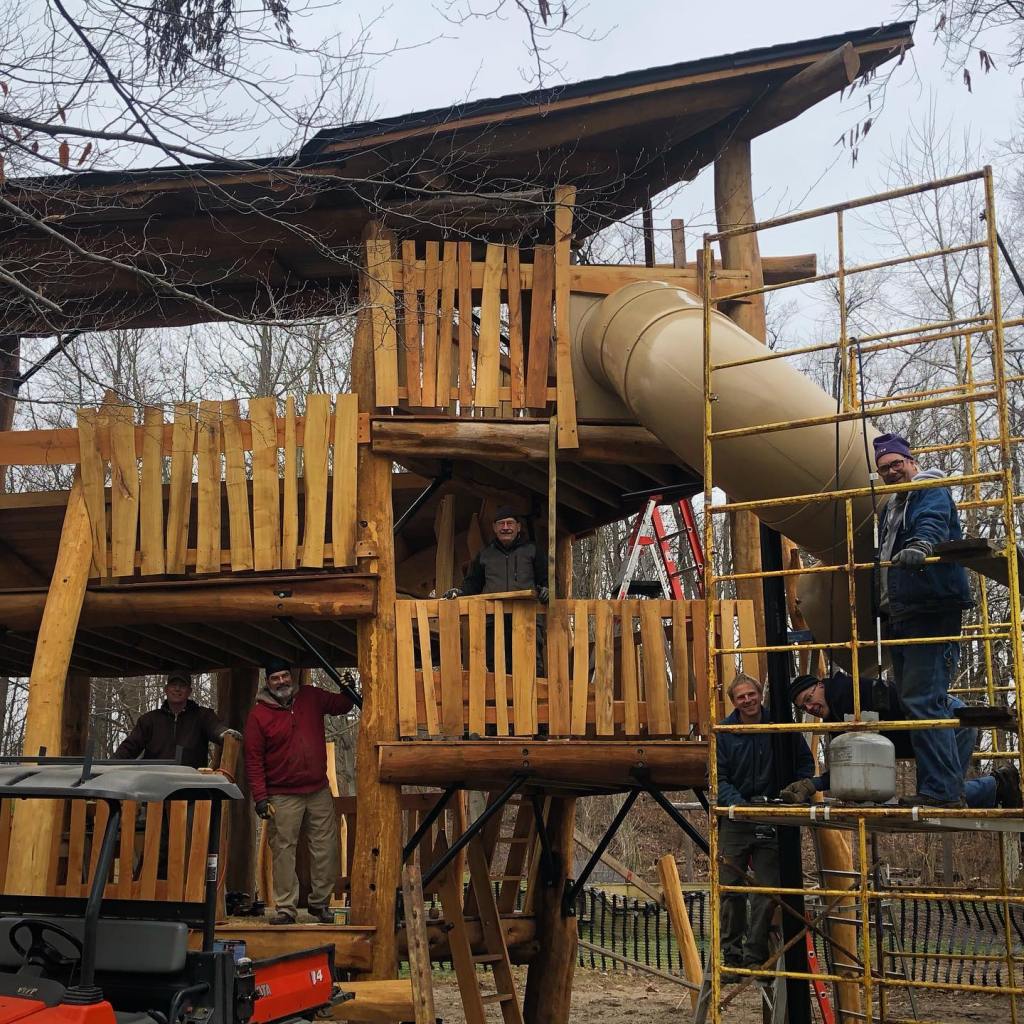
The picture I’m including here is ripped from the internet, but it’s from a camp that is important to our family. This camp did research on playgrounds and safety and created a play structure that is way more fun than your average American playground. They’re not the only ones starting to pay attention to the role of risk in play. People across the US are realizing the importance of risk in play.
Hopefully we’ll find ways to encourage our children to test their limits and learn (without adults) what they are and are not capable of. I like to think that we’ll find ways to listen to more women like Ina May Gaskin, Michaeleen Doucleff (who listens to the women from ancient cultures) and mothers like Sara Zaske and Christine Gross-Loh. All of these women are passing on information that doesn’t rely exclusively on statistics or data. They’re passing on knowledge and wisdom of what works in parenting. Ideally, this will help us become less of a culture with WEIRD parenting and more of a culture with wise parenting.


 Anabaptist Mama