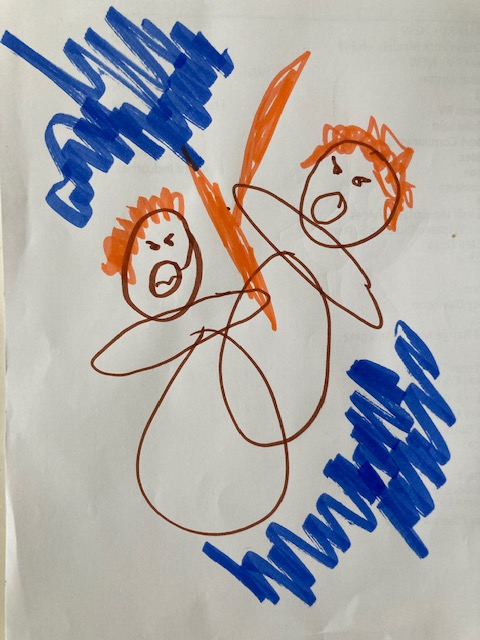
Take time in the next few days to just observe conflict in children and adults. Do you rush to intervene? Can they get through it by themselves?
Well, the moment has arrived. Our child has officially lost her wings. She is no longer just angel. She has realized that she has more options than simply hugging other children. She can hit them. She can even shove them. Goodness!
We were in a group of people that were both parents and children. The children were singing together and our daughter made her way over to another little boy – younger than her and still wobbly on his feet. I thought she was going to hug him because that has been her practice in the past. Nope. She put a full hand on his back and gave him a solid shove. This stocky, solid little boy fell down, looked up and with hurt innocence in his eyes he started getting fussy. (I remember our daughter looking at another child like that at one point when she was similarly pushed. I thought he was a bully.) She just stood over this child she pushed down and looked at him. Another little girl with physical handicaps was obviously having fun and trying to keep her balance while she jumped up and down with joy. Her thin, brown ponytails were flipping around before she lost her balance, landed on her bottom and rolled onto her side with a bad arm. Our daughter pushed her, too.
I struggled with how to respond. I come from an Anabaptist background. We’re pacifists. We emphasize peace and reconciliation. If someone strikes you on the cheek, turn the other cheek. (This scripture has political implications making it more than just a call to be nice and passive, but that’s for another time.) The natural reaction in me is to rush to the aid of the other child and apologize to other parents on behalf of our daughter. Our culture emphasizes this tendency, too.
Children in the United States who fight or are just playing are frequently interrupted by adults. They’re pulled apart, scolded for things they’ve said, asked to return toys, forced to apologize, etc. That’s normal, right? We want children to grow up to be kind people. Don’t we? So we should be intermittently interjecting when needed. Everybody in the world does this. Right? Wrong. Turns out that some people actively practice letting children fight it out.
In her book, Parenting Without Borders, Christine Gross-Loh names that “in [Japan] a country known for its pacifism and low crime rates (homicide by gun is virtually unheard of)” teachers actually teach children how to make their own weapons (guns, swords, etc.). When kids push, hit, or argue verbally, they don’t interrupt and they don’t correct. They let the conflict play out. They assume the children will find their own solutions.
The belief is that when you’re a child, you have to learn how it feels to fight and be angry, how it feels to have a bad relationship and then learn to forgive and make up. Learning how to deal with tension and conflict is best learned as a child. In fact, it’s part of their work to become mature adults who know how to release anger when they’re older and who have learned how to not get caught up in petty conflicts.
I fully believe the practice works. My favorite grandmother (who married into the family at age 45) worked in Japan for many years as a principal. I’ve heard stories of the Japanese people being gentle and soft spoken. Still, leaving children to fight for themselves feels a bit like standing on a treehouse platform with a rope swing in your hand. You know the rope will hold you, but jumping is a completely different thing. I do think it would work to let her go around shoving kids and seeing their reactions. I think she’d learn quickly that actions like these don’t foster good relationships, but we don’t live in a culture that supports this kind of learning and I hate the idea of other parents becoming enraged or even irritated at her and/or me/us.
I’m thankful for one friend who has mentioned in passing that she’s a believer in letting kids duke it out for themselves. Before reading this book I thought she was a little crazy in the head. When her daughter pushed my daughter a couple months ago the mama bear in me started waking up. (Oops! Crazy what buttons a little child can push in a person!) Now I’m kinda curious. I want to see them have a conflict and observe what happens when they hurt one another. I’m sure the ingrained North American value of interrupting and smoothing everything over for the child/children will kick in, but I want to experiment with this for a bit. I want to see how she and others react to unkind treatment. I also want to talk with her more about where she got this idea of letting them fight for themselves. There’s an element of trust in this stance that many people don’t have in children.
If there’s one positive lasting aftertaste in my mouth following the interactions we had at that last gathering with my daughter shoving other kids, it’s gratitude for one wise woman. This woman stopped for a bit amidst the chaos in the group and looked at me. She must have been able to see my discomfort and confusion as to how to move forward. She wondered out loud (as she looked at me) how many of the children were Covid babies. I nodded to indicate that our child is one. She commented that these children are very much learning about touch and what is and isn’t ok touch. I was so very grateful for her naming this reality. She offered the parents around us a helpful way of thinking through developmental stages and saw our daughter’s actions as a natural part of learning about life. In her own American way she offered us grace by naming that this aggression is a movement towards understanding relationships better.
Hallelujah for different cultures and older women who offer wisdom and for grace in the unexpected moments of chaos.

 Anabaptist Mama