“Remember, too, that at a time when people are very concerned with their health and its relationship to what they eat, we have handed over the responsibility for our nourishment to faceless corporations.” -Lynn Rossetto Kasper
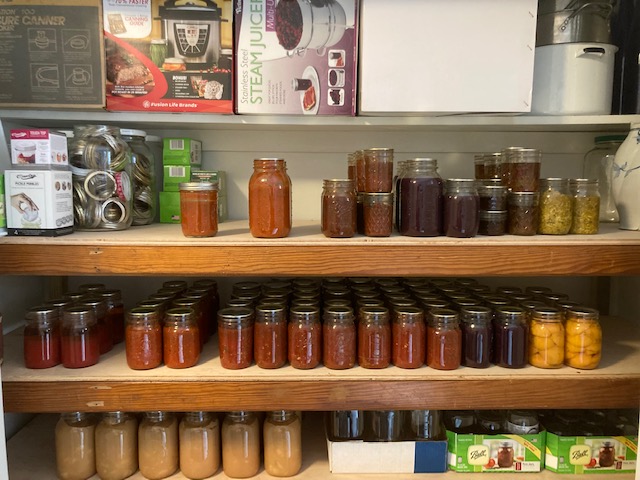
Please let me toot my own horn. I finally put up the last of the canning for the season – 28(ish) quarts of applesauce. Also 8 pints of peaches (the leftover ones that my parents didn’t want), 46 pints of salsa, 8 pints of tomato juice and 7 pints of pizza sauce. The rest of the jars in this picture are from the previous two years and I am so incredibly proud of my work on all this food.
(Allow me to toot my horn once again – because a woman who stays at home with her child only has a certain amount of victories in a day. Building canning shelves is one of those victories. I built them with a childhood friend who now lives on the West Coast. We bought some of the wood, but also retrieved wood from my dad’s garage. After incorporating those long, narrow, brown boards with dings and scrapes in them I learned that they came from the discarded pews in my childhood church. They’re doing a mighty fine job of holding all that weight and we did a mighty fine job of building them to be sturdy.)
In her cookbook, More-with-Less: Recipes and suggestions by Mennonite on how to eat better and consume less of the world’s limited food resources, Doris Janzen Longacre writes, “Home preserving that accompanies gardening is a long-standing tradition in rural Mennonite homes…” But canning isn’t for everyone. A friend walked into my house and saw all the jars I had canned sitting idly on our island counter and taking up a rather large portion of space. I mentioned that I had just spent two days working on these jars and her comment was that I had to decide whether or not the canning was worth the effort (with the slightest hint that perhaps it’s not actually worth all that work). I had to smile inside. It’s true. She’s right. Canning is a ton of work, but I know what’s in those jars. And after years of watching my parents delight whenever they heard the ping of a lid sealing, I also get a deep sense of delight and a sense of lasting contentment every time I open the pantry. There is a clear beginning to the job and a clear stopping point. When the job is completed I fully embrace the task of lining up all those rainbow colors. I wish food always had this level of contentment.
Growing up we all worked together to can produce. Now I tend to work alone since my spouse doesn’t enjoy canning, but I did convince him to help me peel apples for one hour this year. I also made it a point to pick up our child and place her on a chair where she could watch us work. She spent most of that time reaching for whatever apples her hands could touch, but she received an early start on recognizing what goes into canning. You wash. You peel. You chop. You dump. You stir. Then you ladle and wait until the timer is up and the jars come out. And the waiting continues until the next day when the jars are fully cooled.
Yes. It’s work. It’s also theology. It’s philosophy and a way of thinking about life. Work the ground. Go slow. Do good to the earth and thus to people. Do less, but gain more. If you do this, you will help those who are in need. It will be woven into your quiet life and you won’t have a reason to boast. If you want a sense of Mennonite philosophy and also how we sometimes view the world, read More-with-Less. Better yet, read that and Janzen Longacre’s follow-up book, Living More with Less. Combined, the books are full of facts, creativity and encouragement. They aim to help families eat better and more simply and to do it with joy. Eating mindfully and simply can be a way of caring for people all around the world. Choosing to garden means you don’t have to unwrap food from plastic that took precious resources to create. Also, there’s less trash. If you’re growing your own garden, you’re hopefully building up the soil naturally so you don’t have to use excessive amounts of insecticides or herbicides, which alter earth’s natural systems. If you’re choosing to eat less meat, then you’re helping to lower methane gasses. When you can you’re not receiving a shipment of food that came from thousands of miles away and you’re reusing glass jars rather than recycling canned foods from tin. Another way to say this is, live simply so that others may simply live. Lynn Rosetto Kasper is credited as saying, “Remember, too, that at a time when people are very concerned with their health and its relationship to what they eat, we have handed over the responsibility for our nourishment to faceless corporations.” How can we take on lifestyles and jobs that allow us to take more control over the foods we put into our bodies rather than handing that large, spiritual task to faceless corporations?
Janzen Longacre writes, “In our complex world, it is hard to visualize how the struggles of a few families to save food will help. Channels to the needy are long and circuitous. Yet deconsumption is an obvious first step. The very complexity that frustrates easy answers also means that our decisions in the global family are interrelated.” She then quotes Frederick Buechner who points to this idea in The Hungering Dark, when he says, ‘Life is like a huge spider web so that if you touch it anywhere you set the whole thing trembling.’”
When I put all these lovely colors on the shelves and step back to look at them, I’m so proud. I don’t yet have the magic yet of what Greg Brown attributes to his grandmother who “cans the songs of the whippoorwill and the morning dew and the evening moon,” but I do believe that I’ve managed the trick of putting a little taste of the summer in jars.

 Anabaptist Mama