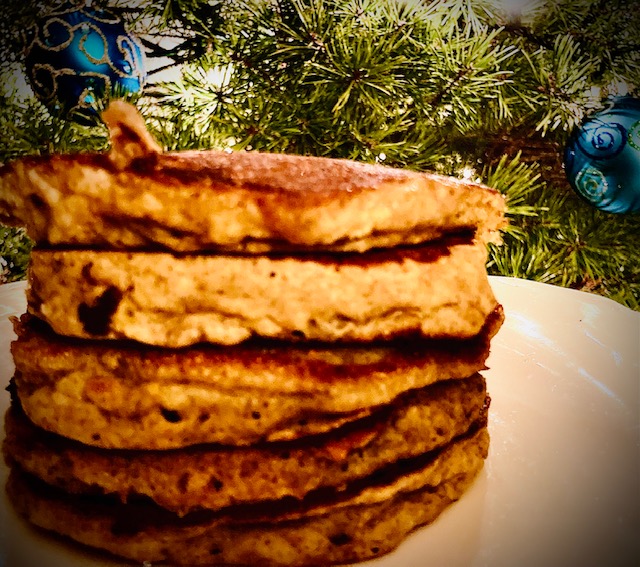
“Drama is very important in life: You have to come on with a bang. You never want to go out with a whimper. Everything can have drama if it’s done right. Even a pancake.” Julia Child
Do you want to know why I love this quote? Because it reminds me of my father who makes excellent pancakes. He does it without drama, but when he makes them they’re done right. I now carry on the tradition of making quality, homemade pancakes (with a bang) on weekends.
My parents knew how to give us quality food. Pa, as we call him, did some cooking in the kitchen, but his real contribution was that he was the driving force behind all the canning we did growing up. Mom made meals with whole grains long before it was hip. She decreased sugar in recipes before the general public understood its perils and she encouraged more vegetable eating. Growing up I didn’t always appreciate gardening, canning, the emphasis on veggies and low sugar, however, as I got older I realized what a gift they handed me. But life happens and it’s easy sometimes to fall into cultural norms.
I was getting lazy with cooking wholesome meals until I got pregnant. Suddenly I started to eat the rainbow! I also started eating more hot food and curry! When our little dumpling popped out, I continued attempting to eat wide varieties of food so she’d experience them through the breastmilk. Once she got old enough to eat solid foods we started her on chicken tikka masala. Yup.
I was seriously inspired by Karen Le Billon’s book, “French Kids Eat Everything.” If the French are known around the world for their food, then why not learn from them how they feed their children? The French introduce their children to as many flavors and textures as they can and they start when the child is old enough for solid foods. I am so grateful that I forgot the warning of my pediatrician who advised me to introduce her to one food at a time and then wait a few days for an allergy reaction. Our child, like most children, was curious about food so we carefully fed her the food we ate. It brought her joy. Us, too. Now, she eats a wide variety of foods, though we still need to work on white potatoes, red beets and regular tomatoes. She’ll strip a cherry tomato plant though, if you look the other direction for three seconds.
I stay home these days and pretty much my whole life is spent in the kitchen. I wake up, make breakfast, don’t clean up, make lunch, try to clean up, begin on supper, wish I had cleaned up at lunch and then want to leave the kitchen when the meal is finished. The unglamorous life I live is done in order to feed my daughter nourishing meals. No wonder mom doesn’t enjoy cooking now. She did it for a family of six over a period of many years. Living in the kitchen isn’t my idea of a fun life. I’d rather be working at least part time out of the home, but right now, another job just doesn’t sit well and cooking meals for the little one seems important.
Many other women work part time or full time and can’t make meals from scratch. I want to tread carefully here. I don’t wanna sound hoity toity. I do, however, feel compelled to offer a suggestion to anyone who wants homemade meals, but doesn’t have the time. Consider gathering a friend or two, maybe connecting with yer mama or someone from your local congregation or reading group. Invite them to spend a day with you creating frozen meals to freeze and throw in the crockpot once a week. Or make whole batches of muffin quiches, bierocks and soup to freeze for later. And focus on the flavor.
In French Kids Eat Everything, one of my favorite stories had to do with a committee that focused on flavor and variety. Did you know: France has a group of people devoted to menu planning for French school children! Le Billon tells a story of sitting in on a three hour meeting (if I’m remembering that correctly) and listening to their conversation.
The group focused on maximizing flavors. At one point, while discussing the Christmas meal, one person suggested a particular cheese. Everyone around the table agreed, but then another person recollected that they had already proposed that cheese for a meal a few weeks earlier. Oops. Back to the drawing board. They reassessed and chose a different cheese. What would our nation look like if we had a board like that looking over the food our children were eating at school?
I know life is more complicated than just a cookie cutter solution to the problems of children in the US eating well. I certainly don’t know all the answers to the food questions and I don’t have it all together, but I’m happy with the foods Mom and Pa taught me to value. I’m also happy to pass some of those values on to our child.

 Anabaptist Mama